Service
Minor Works
Small jobs done properly — kitchens, bathrooms, decks, sheds, sleepouts.
What's covered
Small-scope work that's still worth designing properly. The most common minor-works briefs are:
Kitchen and bathroom refresh
Layout changes, removing or moving walls, checking load paths where walls come out. A consent is triggered if you're adding a fixture that wasn't there before — a new toilet, a second bathtub — but the project still sits within the minor-works scope. Cosmetic-only refreshes (replacing finishes without moving fixtures or walls) are usually outside it entirely; a simple plan is sometimes still useful, but doesn't need a consent or a full design fee.
Decks, sheds, sleepouts
Schedule 1 exempt where they fit the size and location rules; full Building Consent where they don't. Either way the design work is the same — the difference is whether the council also asks to see it.
Carports, pool fencing, retaining
Small standalone structures and rule-driven elements. Pool fencing in particular needs to meet specific Building Code clauses around child safety; retaining walls under 1.5 m are often Schedule 1 but the structural design still has to be right.
Two paths
Schedule 1 exempt — no Building Consent. Drawings, a planning rules check (the District Plan still applies), and a code-compliance memo so you have evidence the work was designed to code.
Full Consent — needs a Building Consent. Drawings, the consent application, RFI handling, and a Certificate of Design Work for the Restricted Building Work in the design. Where the structural scope goes beyond what a designer self-certifies — bigger spans, unusual loads, retaining over 1.5 m — a structural engineer comes in for that piece, and the consent set knits the two together.
For when each path applies, the article on Schedule 1 walks through it — see /articles/schedule-1-building-consent-exempt-nz.
Granny flats
Granny flats sit *outside* minor works. From 15 January 2026, small standalone dwellings up to 70 m² sit under their own consent exemption pathway (Building and Construction (Small Stand-alone Dwellings) Amendment Act 2025) — separate from Schedule 1, with its own conditions: LBP design and supervision, 2-metre setback from buildings and boundaries, council notifications either side of construction, and a Project Information Memorandum before starting. The full rules are in the dedicated granny flat article — see /articles/granny-flats-nz-rules.
How the fee works
Quoted bespoke. The realistic range is roughly $500 to $3,000 + GST for the design fee, sometimes more if the scope is genuinely larger than "minor". Examples:
- A simple deck design within Schedule 1 — drawings, code-compliance memo, builder-ready details. Lower end of the range.
- A bathroom refresh with a wall coming out and a new toilet position — drawings, planning rules check, structural notes for the wall removal, consent application. Mid-range.
- A larger sleepout or carport with structural complexity — top of the range.
Every minor-works enquiry gets a tailored number with the scope agreed in writing before any fee is confirmed. No number gets thrown at someone without a conversation about what's actually being done.
3D visualisation
Optional extra on minor works rather than included. The work is usually small enough that 2D drawings give the builder everything they need. Where a render genuinely helps (a kitchen with custom joinery, a sleepout with an unusual roof form), it's quoted on top.
A real example
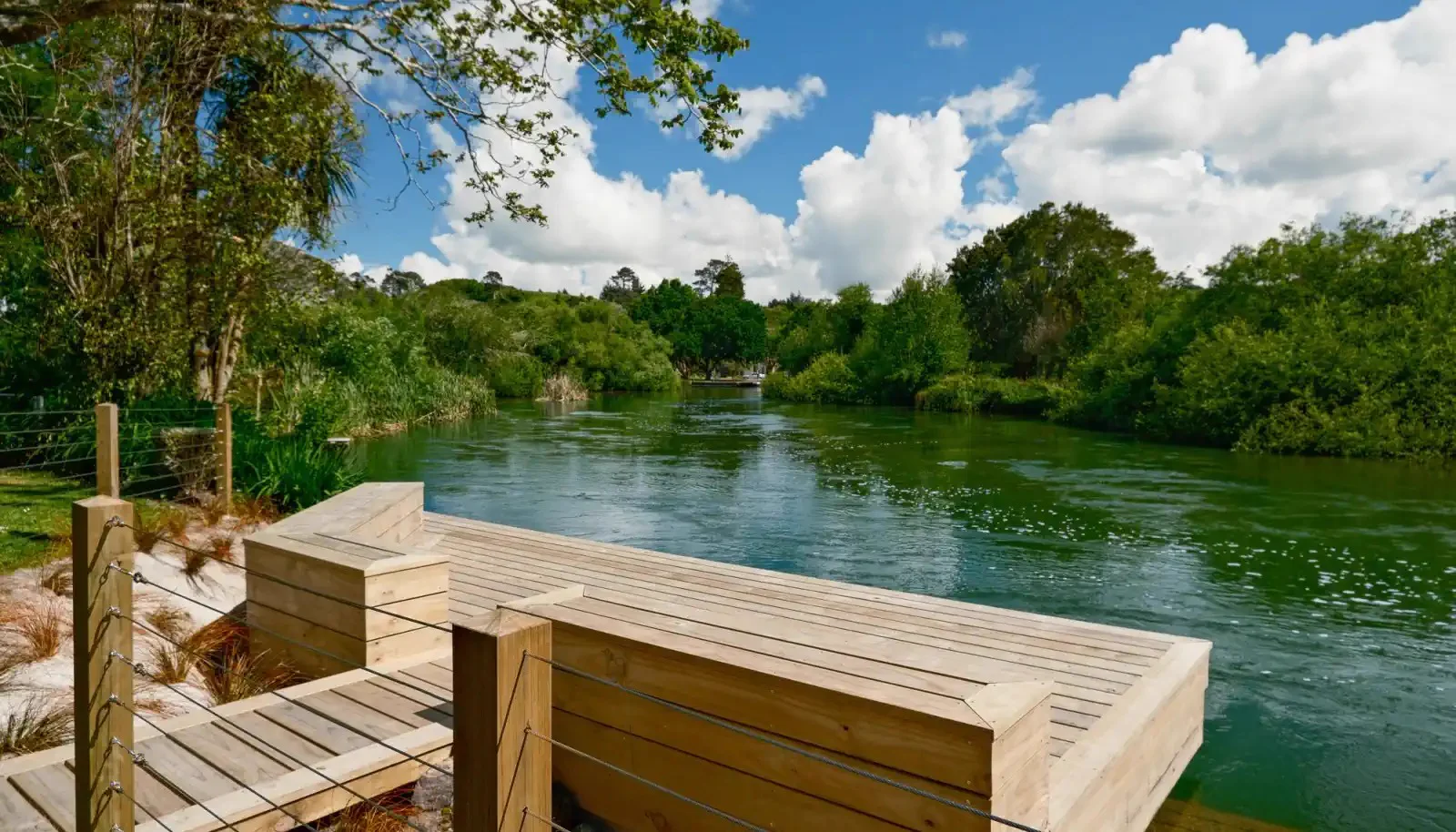
Ohau Boat Deck — a riverside deck rebuilt from the piles up, matching the original form and footprint with upgraded timber sizes and treatment grades. A gangplank was added to deal with bank erosion that had eaten the original step; stainless steel wire fencing was added between posts to address the fall hazard while preserving the views. Bank planting was used to manage the erosion — retaining wasn't an option because any structure touching the lake bed would have triggered Resource Consent. Schedule 1 exempt, no Building Consent, but full design: H6 driven timber piles, M12 bolted connections, 304 stainless hardware throughout.
How a minor works project runs
-
Conversation about scope
Send a description of what you're planning. A quick conversation — phone call or site visit — establishes scope and confirms which path the work falls under (Schedule 1, minor consent, or beyond minor works). No charge for that, no obligation. Talk before you start, not after.
-
Quote + scope agreement
A scope and fixed fee in writing before any drawings start. For most minor works that's one page; the engagement is short enough that a heavy proposal isn't useful.
-
Concept
Initial sketch of the desired outcome — one round of revision included so the design can be tuned before working drawings start.
-
Drawings
Existing-conditions where relevant, proposed drawings to the level of detail the builder and (where applicable) the council need. Structural notes referencing NZS 3604 where applicable, or referred to an engineer where it isn't.
-
Council coordination or drawings issued
Where consent is needed: lodgement, RFIs, certificate at the end. Where the work is Schedule 1 exempt: a planning rules check is part of the scope (the District Plan still applies, even when consent doesn't), and the builder-ready drawings are issued for construction.
Frequently asked
- Do I need a Building Consent for a deck or shed?
- Maybe — Schedule 1 of the Building Act exempts a long list of small structures from Building Consent, but the size, location and use have to fit. The work still has to comply with the Building Code and the District Plan either way. Easiest move: call before you start. A quick conversation costs nothing, and you'll know which side of the line your project falls on. Even where consent isn't needed, a simple set of drawings is often worth having — both for the builder and for your records when you sell. Talk before you start, not after.
- How much does minor-works design cost?
- Realistic range is roughly $500 to $3,000 + GST, sometimes more if the scope is larger than 'minor'. A simple deck design within Schedule 1 sits at the lower end; a bathroom refresh with a wall coming out and a new fixture sits in the middle; a larger sleepout or carport with structural complexity sits near the top. Every minor-works job is discussed before a number is quoted — no number gets thrown at someone without context.
- Are kitchen and bathroom refreshes minor works?
- Yes — even when consent is triggered. Adding a fixture that wasn't there before (a new toilet, a second bathtub) triggers a Building Consent, but the project still sits within minor-works scope. Cosmetic-only refreshes (finishes only, fixtures stay where they are) usually don't need consent at all and don't need full design fees, though a simple plan is sometimes still useful.
- Is a granny flat minor works?
- No — granny flats sit on their own consent exemption pathway, in force from 15 January 2026. Small standalone dwellings up to 70 m² can be built without a Building Consent if the design meets the conditions (LBP design + supervision, 2-metre setback, council notifications, PIM before starting, services connections). The dedicated article on granny flat rules walks through it — see /articles/granny-flats-nz-rules.
- Are 3D renders included?
- Optional extra on minor works rather than included by default. Most minor works are small enough that 2D drawings give the builder everything they need. Where a render genuinely helps (custom joinery, unusual roof form), it's quoted on top.
Ready to talk?