Stoak Journal
Do I need a building consent? Schedule 1 in plain English
Not every building project needs a Building Consent. Schedule 1 of the Building Act 2004 lists the work that's exempt — but "exempt" doesn't mean "unregulated." Here's how to read it without the legal headache.
What Schedule 1 is
Schedule 1 of the Building Act 2004 lists a long set of building work that's exempt from needing a Building Consent. The full list is in the legislation itself (Schedule 1 — Building Act 2004) and MBIE publishes a plain-English guide at building.govt.nz.
The catch — and it's the bit people miss — is that an exemption only removes the requirement to apply for a consent. The work still has to comply with the Building Code, the District Plan, any covenants on the title, and any other Act it falls under (Resource Management Act, Plumbers Gasfitters and Drainlayers Act, etc.).
Common exemptions, in rough plain language
This is a summary — for any specific project, check the actual legislation or your council. The exemptions that come up most often in residential work:
Detached single-storey buildings (sheds, sleepouts, studios)
The Building Act allows a detached single-storey building to be exempt under specific conditions. The most common path is 10m² to 30m² floor area, single storey, built using lightweight materials to Acceptable Solution B1/AS1, with no plumbing or potable-water storage, and no sleeping accommodation unless it's connected to a dwelling and has no kitchen. Buildings under 10m² have a separate, lighter rule. Buildings closer than 1m to a residential building or boundary fall outside the exemption.
There's an alternative pathway for the same size band (10–30m²) where the design or construction work is carried out or supervised by a Licensed Building Practitioner — the lightweight-materials rule loosens up but the size limits don't.
A 30m² sleepout for the kids is the classic example. Add a kitchen or a shower and it stops being exempt.
Decks at low level
Decks not more than a small distance above the ground are typically exempt. Above that height it's a Building Consent — handrails become structural, falls-from-height detailing comes in.
Carports
A free-standing carport, openings on enough sides, is typically exempt up to a limit. Add a wall and it becomes a garage, which needs a consent.
Fences
Fences up to 2.5m are typically exempt from Building Consent (subject to other rules). Pool fencing is its own beast — the Building Code's pool barrier requirements apply.
Retaining walls
Retaining walls below a certain height and not supporting a load above (a building, driveway, or parked car on top) are typically exempt. Above that, a consent and an engineer's design come in.
Granny flats — separate exemption pathway
From 15 January 2026, small standalone dwellings up to 70 m² can be built without a Building Consent under a separate exemption introduced by the Building and Construction (Small Stand-alone Dwellings) Amendment Act 2025. This sits *alongside* Schedule 1, not within it — granny flats have their own conditions, including LBP design + supervision, a 2-metre setback from buildings and boundaries, council notification before and after construction, and a Project Information Memorandum (PIM) before building starts.
It's a meaningful change for property owners thinking about a second dwelling on their section. The full rules are in the granny flat article — worth reading before assuming Schedule 1 covers what you're planning.
> The exact thresholds change. The Building (Exempt Building Work) Order 2020 made significant additions, Schedule 1 has been amended again since, and the granny flat exemption took effect in January 2026. For your specific project, the building.govt.nz exempt-work guide is the easiest place to read the current rules.
What "exempt" doesn't get you out of
This is where most of the trouble starts. An exemption from Building Consent does not remove:
- The Building Code. Your deck still has to be structurally sound. Your shed still has to be weathertight. If it fails, the property owner is liable.
- The District Plan. Council planning rules — height-to-boundary, site coverage, setbacks, recession planes — apply regardless. A 10m² shed in a height-to-boundary breach is still illegal.
- Resource Consent. If your project triggers Resource Consent (special character zone, hazard overlay, removing a protected tree), that's separate. Schedule 1 doesn't touch it.
- Covenants. Modern subdivisions almost always come with private covenants — minimum floor areas, approved cladding lists, no outbuildings without written approval.
- Plumbing and drainage. Even if the structure is exempt, any new plumbing or drainage to it is regulated separately.
How Stoak handles small-consent work
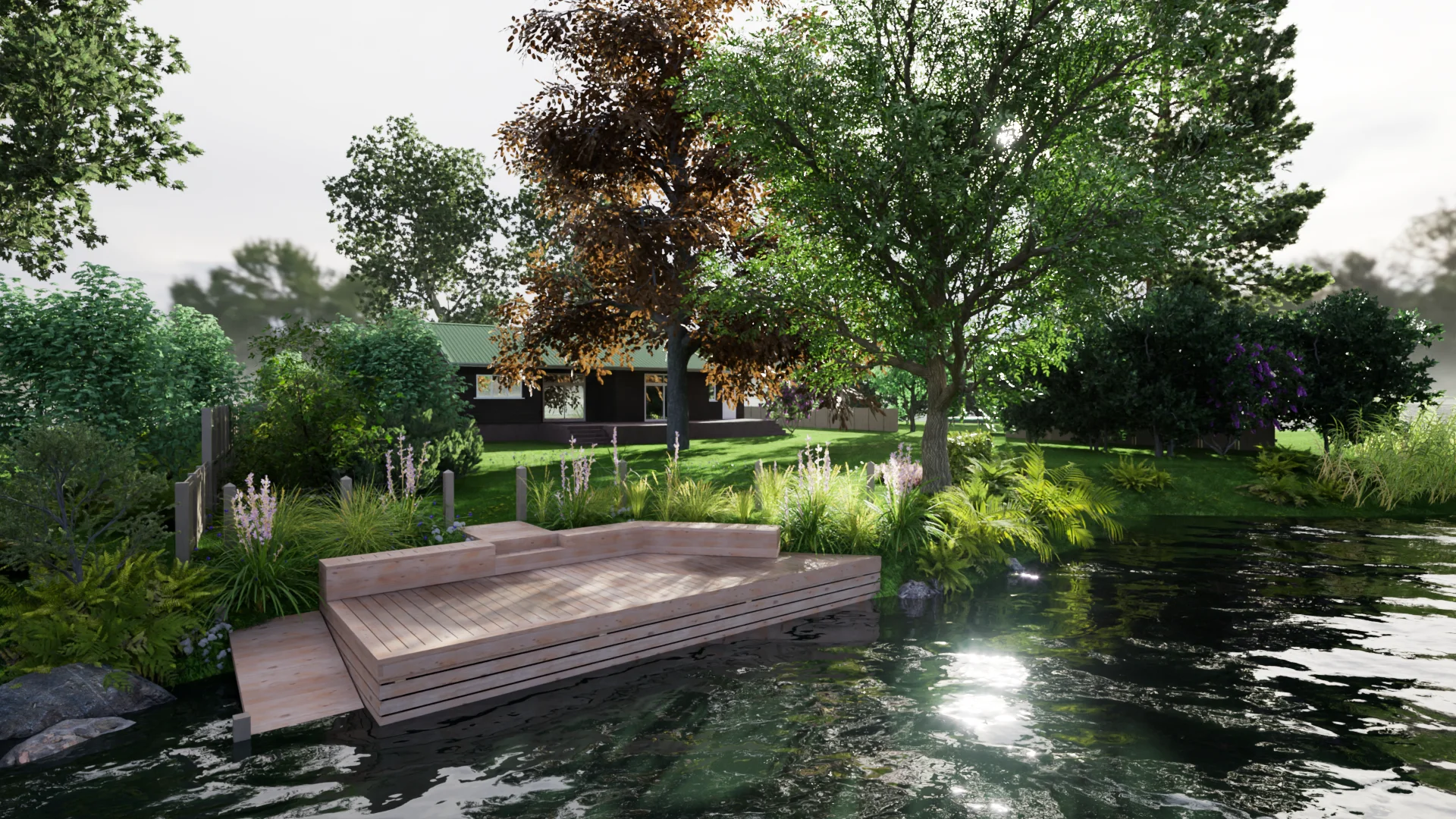
A real example from our Ohau Boat Deck project: the deck itself was Schedule 1 exempt (riverside deck, structural detailing, stainless hardware throughout). What we provided was the drawings the builder needed to actually build it well, and a paper trail confirming the design met the relevant Building Code clauses. No consent application — but full design.
That's the pattern for most "minor works — no consent" jobs. Drawings, a code-compliance memo against the relevant Building Code clauses, planning rules check, and a Certificate of Design Work covering any Restricted Building Work in the design. Where the structural pathway falls outside what a designer self-certifies — bigger spans, unusual loads, retaining over 1.5 m — a structural engineer covers that piece with their own PS1. Quoted on enquiry — see /services/minor-works.
When in doubt, check first
Council's Building Consent line will tell you straight whether something needs a consent. Or send a description of what you want to do through to me — I'll tell you which side of the line it falls on, including when the answer is "you don't need a designer for this, here's what to do yourself."
Set under the Building Act 2004 + Building Regulations 1992
- 01
Acceptable Solutions
Most prescriptive · Deemed-to-comply
MBIE-published prescriptive solutions tied to specific Code clauses (e.g. B1/AS1 for Structure, E2/AS1 for External Moisture). A BCA must accept a design that follows the Acceptable Solution as complying with the cited clause.
NZS 3604 is a NZ Standard that's referenced by B1/AS1 — its deemed-to-comply status flows through the Acceptable Solution, not from the Standard itself.
- 02
Verification Methods
Calculation / test-based · Deemed-to-comply
MBIE-published test or calculation methods (e.g. B1/VM1). Also a deemed-to-comply route under s 19 of the Building Act — typically used where a design needs more analytical flexibility than the Acceptable Solution allows but still falls within an MBIE-published method.
- 03
Alternative Solutions
Most flexible · Designer evidences compliance
Anything else that demonstrates compliance with the cited Code clause — specific engineering design, CodeMark-certified products, in-service history, comparison to an Acceptable Solution. A fully legitimate s 19 / s 22 route, just one where the designer has to show how the design complies.
Worth saying out loud
- All three pathways are legitimate. Alternative Solutions aren't "non-compliant"; they're a different way of evidencing compliance.
- All three still go through BCA assessment. The pathway changes how compliance is demonstrated, not whether it's reviewed.
- NZ Standards (NZS 3604, NZS 4229, AS/NZS 1170, etc.) are not Acceptable Solutions. They're referenced by Acceptable Solutions and Verification Methods — that's how their compliance status flows through.
Diagram redrawn by Stoak Architecture. Based on Building Code compliance pathways content from the Ministry of Business, Innovation and Employment, building.govt.nz, licensed under CC BY 4.0. NZS 3604:2011 is published by Standards New Zealand.
Frequently asked
- Where do I find the actual list of Schedule 1 exemptions?
- The legislation is at legislation.govt.nz under the Building Act 2004, Schedule 1. MBIE publishes a plain-English guide at building.govt.nz under "Building work that doesn't need a building consent" — that's the easiest read.
- If something is Schedule 1 exempt, do I still need to follow the Building Code?
- Yes. Schedule 1 only removes the requirement to apply for a Building Consent — it does not remove the requirement that the work complies with the Building Code. The work still has to be structurally sound, weathertight and code-compliant; if it fails, the property owner is liable.
- Can I add a kitchen or a shower to a Schedule 1 sleepout?
- No. Once a building has a kitchen or sanitary fixtures it stops fitting the exemption — the work then needs a Building Consent.
- Does Schedule 1 mean no rules at all?
- No. Even when Schedule 1 removes the Building Consent step, the District Plan, any title covenants, the Plumbers Gasfitters and Drainlayers Act, and Resource Consent rules still apply. An exemption is narrower than people often think.
- Does Schedule 1 cover granny flats?
- Not directly. Granny flats up to 70 m² have their own consent exemption pathway under the Building and Construction (Small Stand-alone Dwellings) Amendment Act 2025, in force from 15 January 2026. The conditions are different to Schedule 1 — LBP design and supervision, 2 m setback from buildings and boundaries, council notification before and after, and a Project Information Memorandum. The dedicated article on granny flat rules walks through it.
Got a project?
Talk it through with Daniel.
If something here applies to a project you're thinking about, send through a brief — I'll come back to you within one business day.